

Recipe
[55 Years of Experience] Like an Alien! Filleting Monkfish While Keeping Its Shape Intact
Ingredients
- Monkfish(1 giant whole fish)
- Kombukelp (for kelp-curing)
- Monkfishliver
- Soysauce
About "Whole-Style Monkfish Sashimi"
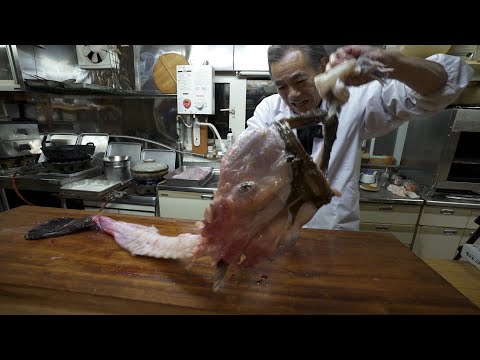
A chef with 55 years of experience demonstrates how to fillet a giant monkfish on a cutting board while keeping its shape intact. He carefully cuts along the backbone to fillet it into three pieces. The filleted meat is then kelp-cured (kobujime) and served with a luxurious liver soy sauce made from fresh monkfish liver. Professional techniques shine throughout, including how to harvest the rare 'cheek meat' and handle the tough skin.
Tips for Making "Whole-Style Monkfish Sashimi"
-
Prep
- While monkfish is famously filleted hanging ('tsurushi-giri'), this video demonstrates filleting it on a cutting board while keeping its shape intact.
-
Filleting Technique
- Carefully cut along the backbone, aiming close to the bone to fillet it into three pieces without damaging the meat. The key is to work carefully to preserve the meat around the fins.
-
Rare Cuts
- The 'cheek' meat is a luxury ingredient yielded in extremely small quantities. Carefully carve it out while working through the tough skin.
-
Ingredient Quality
- Choosing a large monkfish is crucial. The true flavor of monkfish cannot be fully realized unless the liver is large.
-
How to Eat
- The chef recommends curing the fresh meat with kelp (kobujime) and enjoying it with 'liver soy sauce' made by grinding the liver in a mortar and mixing it with soy sauce.
-
Finishing Touch
- Prop the monkfish's mouth wide open to secure it, finishing with a high-impact, alien-like presentation.
Ingredients for "Whole-Style Monkfish Sashimi"
4 items* Tap ingredient names to find on Amazon
How to Make "Whole-Style Monkfish Sashimi"
- 1
Place the freshly procured giant monkfish on the cutting board.
- 2
Using the backbone as a guide, carefully determine where to insert the knife.
- 3
Boldly yet delicately cut along the backbone with the knife.
- 4
While pulling the flesh, carefully slide the knife close to the bone to separate the fillet.
- 5
Cut as close to the bone as possible to ensure the meat around the fins is not wasted.
- 6
Carefully carve out the 'cheek meat' from the monkfish's head while battling its tough skin.
- 7
Prepare the filleted meat for kelp-curing (kobujime).
- 8
Grind the monkfish liver in a mortar.
- 9
Mix the ground liver with soy sauce to make 'liver soy sauce'.
- 10
Enjoy the kelp-cured monkfish with the liver soy sauce.
- 11
Prop the monkfish's mouth wide open to secure it, creating a striking final presentation that showcases its whole form.
Food Science
The combination of inosinate in the monkfish meat and glutamate in the kelp and soy sauce creates a synergistic umami effect. Additionally, kelp-curing draws out excess moisture from the monkfish through osmosis, firming up the flesh and concentrating the umami compounds. Combining the rich monkfish liver with soy sauce adds depth and complexity, further elevating the overall flavor.
Detailed Commentary on "Whole-Style Monkfish Sashimi"
* Content organized by topics from the video.
A Giant Monkfish on the Cutting Board
The video begins with a chef of 55 years placing a freshly procured giant monkfish onto the cutting board. Its overwhelming size draws gasps of surprise from those around him, with comments like 'It's huge!' and 'It looks amazing on the cutting board!' Normally, monkfish are famous for being filleted while hanging (tsurushi-giri), but this time, the chef showcases his dedication and skill by filleting it on the cutting board while keeping its shape intact. The chef explains his reasoning: 'People talk about hanging it to fillet, and that's fine. But this time, I just felt like slicing it right here.' To successfully fillet this giant monkfish into three pieces, he first carefully determines where to insert his knife.
Filleting the Plump Meat into Three Pieces
The chef boldly yet delicately cuts along the monkfish's backbone. Watching staff members sigh in admiration, saying, 'It's so plump...', 'That looks delicious,' and 'I'm getting hungry.' The chef happily remarks, 'This is one for the books,' as he carefully separates the meat from the bone without damaging it. When a staff member suggests, 'Deep-fried (karaage) would be great!' the chef agrees, 'Deep-fried sounds amazing!' as they brainstorm ways to prepare this fresh meat. While monkfish is usually chopped into chunks for hot pot, he carefully slides his knife right along the bone to fillet it beautifully while keeping the overall shape intact.
Exquisite Kelp-Curing and Liver Soy Sauce
Looking at the filleted monkfish meat, the chef suggests, 'This is perfect for kelp-curing (kobujime).' He then shares a luxurious idea: grinding fresh monkfish liver in a mortar and mixing it with soy sauce to create monkfish liver soy sauce (ankou shoyu) to accompany the kelp-cured fish. The staff is thrilled, exclaiming, 'What is monkfish soy sauce?!', 'Making liver soy sauce... that's going to be incredibly delicious,' and joking, 'That's a gout machine...' and 'Gout soy sauce?' The chef proudly speaks of the high quality of this monkfish, noting, 'The liver has to be big, otherwise it's no good. Small monkfish livers just don't cut it.'
Cleanly Separating the Meat from the Bone
Next, he moves on to completely separating the meat from the backbone. 'I need to take my time and stay calm, or I won't be able to harvest the cheek meat cleanly,' the chef says, talking himself through the delicate process. As he pulls the meat and cuts, the staff gasps, 'Wow, it's so jiggly!' The chef highlights the freshness of the ingredient, replying, 'Of course, it was just alive. It's bound to be jiggly.' He carefully shaves the meat as close to the bone as possible to preserve the flesh around the fins, successfully separating a beautiful fillet.
The Rare and Luxurious Cheek Meat
Next, the chef targets the 'cheek' meat located in the monkfish's head. As the chef cuts in, saying, 'The cheeks are delicious,' the staff looks on with envy, commenting, 'I want to eat that as a steak!' and 'You can only get this much, it's such a luxury ingredient.' The chef explains its rarity: 'Exactly, you only get this tiny amount. If the fish were smaller, you'd get even less.' He also passionately discusses the deliciousness of the skin, noting, 'Monkfish skin is delicious. It's one of the seven tools of the monkfish (seven edible parts).' Battling a skin so tough it dulls the knife, he carefully carves out the cheek meat.
A Striking, Alien-Like Presentation
Finally, he moves to the finishing touches that showcase the monkfish's whole form. 'Let's open the mouth wide, like "Gwaaar!"' the chef says as he props the monkfish's mouth wide open. The resulting look resembles an alien from a movie, prompting laughter and groans of 'Whoa, gross!' and 'It's creepy!' from the staff. The chef reveals his playful, professional spirit that values visual impact: 'It's better to leave it like this on purpose.' Regarding a small hole that opened in the skin, he boldly declares, 'I'll stitch it up from the inside later!' and successfully completes the filleting process while keeping the monkfish's striking form intact.
About こぶしの板さん
こぶしの板さん
9.9万人 subscribers ・ 和食・天ぷら
* Opens YouTube channel
* Subscriber count is as of article creation and may differ from the current number.
