

Recipe
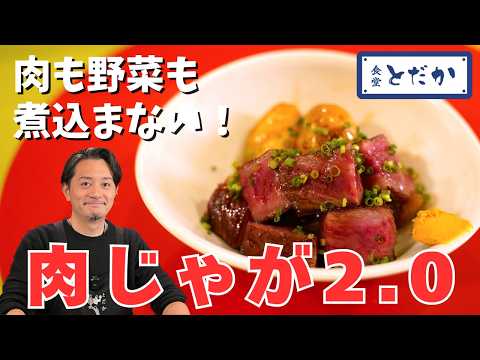
"Nikujaga 2.0" - Wait, Is This Steak? Potatoes Made Delicious with a Sauce Simmered from Veggie Scraps!
Ingredients
- 10–15new potatoes
- 300gbeef block (aitchbone/rump cap)
- Choppedgreen onions, to taste
- Japanesehot mustard, to taste
- [ForSauce] 2 onions
- [ForSauce] 1 carrot
- [ForSauce] 1–2 burdock roots
- 100mlsoy sauce
- 100mlcooking sake
- 100mlmirin
- Apinch of salt (for seasoning the beef)
About "Nikujaga 2.0 (Aitchbone Steak and New Potatoes in Savory Umami Sauce)"
Created by Chef Yuhei Todaka of "Shokudo Todaka," "Nikujaga 2.0" is a new style of Japanese beef and potato stew. It features a whole beef aitchbone cooked like a steak, finished with a rich, sukiyaki-style sauce extracted from vegetable scraps. The vegetables for the sauce (onions, carrots, and burdock root) are used solely to extract umami, leaving only the meat and potatoes in the final dish. The key is the concentrated sauce made by sautéing the vegetables in beef tallow, simmering them with soy sauce, sake, and mirin for 15 minutes, and then straining. Served with chopped green onions and hot mustard, it pairs perfectly with the sweet and savory sauce. This versatile sauce can also be refrigerated and used for pork bowls or stir-fries.
Introduction to 動画 de 食堂とだか 料理人・戸高雄平 →
Tips for Making "Nikujaga 2.0 (Aitchbone Steak and New Potatoes in Savory Umami Sauce)"
-
Ingredients
- Aitchbone is ideal, but any lean block of beef like fillet, rump, or sirloin works. Using a whole block is key to this recipe.
-
Prep
- Boil the new potatoes with their skins on, starting from cold water. Cook for about 20 minutes after boiling to ensure they are fully cooked.
-
Prep
- Trim the fat from the beef block and render it in the pan to sauté the sauce vegetables. This utilizes the meat's flavor with zero waste.
-
Sauce
- The vegetables for the sauce (onions, carrots, burdock) are purely for flavor extraction, so any cut works. Leftovers and scraps are perfect.
-
Sauce
- Sauté the vegetables in beef fat until they change color, then add 100ml each of soy sauce, sake, and mirin. Simmer on low for 15 minutes until slightly thickened.
-
Sauce
- Strain the simmered sauce through a sieve, pressing the vegetables firmly with a spoon to extract every drop of umami. Discard the pulp.
-
Sauce
- Since this sauce contains no water, it keeps well in the fridge. It is highly versatile and can be used for pork bowls, stir-fries, or shirataki noodles.
-
Heat Control
- Cook the beef block whole with a pinch of salt. Use medium-low heat, occasionally covering with a lid off the heat to cook gently with residual heat. Avoid overcooking.
-
Heat Control
- After cooking, remove the beef from the pan and let it rest before slicing in half to check the doneness.
-
Finishing
- Return the potatoes (halved if large) and beef to the pan, pour in the sauce, and toss to coat everything thoroughly.
-
Plating
- Plate potatoes in a bowl, top with bite-sized beef, drizzle with sauce, and scatter green onions. Serve with hot mustard, which pairs perfectly with the sweet sauce.
Ingredients for "Nikujaga 2.0 (Aitchbone Steak and New Potatoes in Savory Umami Sauce)"
11 items* Tap ingredient names to find on Amazon
How to Make "Nikujaga 2.0 (Aitchbone Steak and New Potatoes in Savory Umami Sauce)"
- 1
Fill a large pot with water, add the unpeeled new potatoes, and bring to a boil. Once boiling, cook for about 20 minutes until a bamboo skewer slides through easily.
- 2
Trim the fat from the beef block (aitchbone) with a knife to secure beef tallow.
- 3
Finely chop the onions, carrot, and burdock root for the sauce. The cutting style doesn't matter; scraps or leftovers are perfectly fine.
- 4
Place the trimmed beef fat in a frying pan over heat. Once the fat melts, add all the chopped vegetables.
- 5
Sauté thoroughly until the vegetables are well coated in fat and lightly browned.
- 6
Add 100ml soy sauce, 100ml cooking sake, and 100ml mirin in order. Simmer over low heat for about 15 minutes until slightly thickened.
- 7
Place a strainer over a bowl and pour in the simmered sauce. Press the vegetables firmly with a spoon to squeeze out every drop of umami extract. Discard the vegetable pulp.
- 8
Heat another frying pan, lightly season the beef block with salt, and place it in the pan. Cook slowly over medium-low heat, occasionally turning off the heat and covering with a lid to cook gently using residual heat.
- 9
Remove the cooked beef from the pan and let it rest for a few minutes.
- 10
Add the boiled potatoes to the pan used to cook the meat (cut larger ones in half, leave smaller ones whole). Sauté lightly.
- 11
Cut the rested beef in half to check the doneness. Add it back to the pan and turn the heat to medium.
- 12
Pour the strained sauce into the pan, tossing the potatoes and beef to coat them thoroughly.
- 13
Plate the potatoes in a small bowl, slice the beef into bite-sized pieces, and place them on top. Drizzle with the sauce, scatter chopped green onions, and serve with Japanese hot mustard on the side.
Detailed Commentary on "Nikujaga 2.0 (Aitchbone Steak and New Potatoes in Savory Umami Sauce)"
* Content organized by topics from the video.
Shokudo Todaka's Take on Nikujaga
Chef Yuhei Todaka welcomes guest Masato Kogure from "Netafull" for a lively session. Following the huge success of the "Shokudo Todaka-style Ginger Pork" introduced two episodes ago, they are tackling another household classic: Nikujaga (beef and potato stew). However, instead of a standard recipe, Chef Todaka shares a special version served at his restaurant. Kogure, appearing for the second consecutive week, keeps the energy high with great chemistry from the start. Anticipation builds as they begin to transform a home-cooking staple into a professional masterpiece.
Literally Just "Meat" and "Potatoes"
The ingredients for this Nikujaga are simple: 10 to 15 new potatoes and a 300g block of beef (aitchbone). The beef can be substituted with fillet, rump, or sirloin. For the sauce base, they prepare 2 onions, 1 carrot, and 1 to 2 burdock roots, along with 100ml each of soy sauce, cooking sake, and mirin. Surprisingly, the vegetables for the sauce are treated as "scraps" used solely to extract umami, not for eating. Kogure is amazed by this luxurious concept where only meat and potatoes remain in the final dish.
Boiling Potatoes & Prepping Sauce Veggies
Cooking begins by boiling the unpeeled new potatoes starting from cold water. They simmer for about 20 minutes after boiling. Meanwhile, the vegetables for the sauce are finely chopped. Since their purpose is to make a flavorful stock, any shape or size works, making it a great way to use up carrot tops and other scraps. Additionally, the fat is carefully trimmed from the beef block. Sautéing the chopped vegetables in this rendered beef fat is a professional technique that infuses the vegetables with rich meat flavor without any waste.
Simmering the Ultimate Umami Sauce
The trimmed beef fat goes into a frying pan to render. Once the fat melts, all the chopped vegetables are added and sautéed. The key is to stir-fry them thoroughly until they are well coated in fat and start to change color. Once a wonderful aroma fills the air, 100ml of soy sauce, 100ml of cooking sake, and 100ml of mirin are added. The mixture is then simmered over low heat for about 15 minutes until it thickens slightly, filling the studio with an incredibly appetizing aroma.
The Secret of the Versatile Sukiyaki Sauce
Chef Todaka explains the science behind the simmering sauce. It is designed like a "sukiyaki base," capturing the concentrated flavors of various vegetables and meat—reminiscent of the delicious final bites of a sukiyaki hot pot. Because it contains no water, it doesn't spoil easily and keeps well in the refrigerator. Chef Todaka passionately highlights its versatility, explaining that it works beautifully not just for Nikujaga, but also as a sauce for pork bowls, stir-fries, or sautéed shirataki noodles, making it highly recommended to make in bulk.
Finishing the Sauce & Cooking the Steak
Once the sauce thickens, it is strained through a mesh sieve over a bowl. The trick is to press the vegetables firmly with a spoon to extract every last drop of flavorful essence. The leftover vegetable pulp is discarded. Tasting the sauce, Chef Todaka exclaims, "This is delicious on its own!" Next, the beef block is lightly salted and placed whole into a frying pan. Kogure is thrilled by the sight of the beef cooking like a steak. It is cooked slowly over medium-low heat, occasionally covered with a lid off the heat to let the residual heat cook it gently to the center.
A Special Gift: Urawa Craft Shumai
While the meat rests, Kogure presents a wonderful gift: "Urawa Craft Shumai," which he co-developed with Kuniyoshi from "Tonkatsu Tonki." These special dumplings utilize quality pork cuts that cannot be used for tonkatsu, combined with three types of branded pork and locally grown Urawa shiitake mushrooms. While they can be microwaved, steaming them makes them even more delicious. They are best enjoyed as-is without soy sauce. Chef Todaka is absolutely delighted by this thoughtful gesture.
Plating and the Magic of "Nikujaga 2.0"
Now for the final assembly. The boiled new potatoes (cut in half if large) are added to the pan used for the meat and lightly sautéed. Slicing the rested beef in half reveals a beautiful, perfectly rare gradient. The beef is returned to the pan, and the strained sauce is poured over, coating everything beautifully. The potatoes are plated in a bowl, topped with bite-sized slices of beef, drizzled with more sauce, and finished with green onions and a dab of Japanese hot mustard. Tasting it, Kogure dubs it "Nikujaga 2.0." He is thoroughly impressed by the deep vegetable umami and how perfectly the sweet-savory sauce pairs with the mustard.
About 動画 de 食堂とだか 料理人・戸高雄平
動画 de 食堂とだか 料理人・戸高雄平
6,680人 subscribers ・ 和食・居酒屋料理
* Opens YouTube channel
* Subscriber count is as of article creation and may differ from the current number.
