

Recipe
What is Dashi-Yose Tamago? Oil-Free Japanese Egg Dish to Savor Dashi [Part 3]
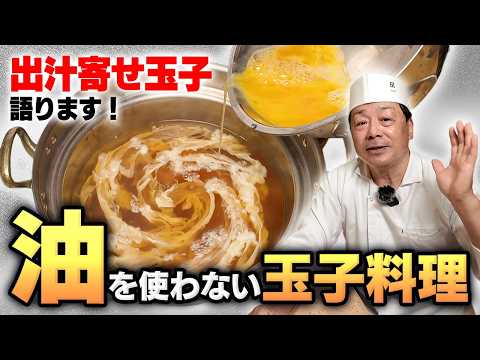
Ingredients
- Eggs,to taste
- Dashibroth, plenty (enough to boil in a pot)
- Daikonradish, cut into rectangular blocks (for shaping, 2 pieces for both sides)
About "Dashi-Yose Tamago"
Dashi-Yose Tamago is a traditional Japanese egg dish made by poaching and gathering beaten eggs in delicious dashi broth without using any oil. Because it is completely oil-free, its main feature is that you can directly taste the delicate umami of the dashi and the natural sweetness of the eggs. Once finished, it can be enjoyed as is, or used as an ingredient for dishes like Agedashi Tamago or tempura. A master chef with 50 years of experience in Japanese cuisine demonstrates and explains the recipe, sharing the differences between Dashi-Yose, Dashimaki Tamago, and Tamagoyaki, as well as how oil affects the flavor of dashi.
Tips for Making "Dashi-Yose Tamago"
-
Prep
- Squeezing the egg mixture through a cotton cloth (sarashi) about twice fully integrates the whites and yolks, creating a smooth mixture that blends perfectly with the dashi.
-
Heat Control
- Create a swirling whirlpool in the boiling dashi with a ladle before pouring in the beaten egg. Since the egg lowers the temperature, adjust the heat and wait for it to gently set.
-
Shaping
- Place a bamboo mat over a bowl, position rectangular daikon blocks on both sides, and scoop the set egg between them using a slotted spoon. Wrap and squeeze gently with the mat to shape it into a rectangle.
-
Zero Waste
- Placing a small plate under the bamboo mat during shaping catches the squeezed-out dashi, which can be reused for grated daikon with soy sauce.
-
Oil Prep
- When using oil for Dashimaki Tamago, heat it to 170°C–175°C (338°F–347°F) for 5 minutes and let it cool first. This 'heating' process mellows the oil so it doesn't overpower the dashi flavor.
-
Food Safety
- Dashimaki Tamago contains a lot of moisture (dashi) and spoils easily, so it should never be put in a bento box. Use water-free Tamagoyaki for bentos instead.
-
Seasoning
- To highlight the delicate umami of the dashi, Dashimaki Tamago should not be browned, and no sweet seasonings like mirin or sugar should be added. Finish gently with only light soy sauce and salt.
Ingredients for "Dashi-Yose Tamago"
3 items* Tap ingredient names to find on Amazon
How to Make "Dashi-Yose Tamago"
- 1
Lightly beat the eggs to make a beaten egg mixture (straining it through a cotton cloth/sarashi makes it even smoother).
- 2
Pour plenty of dashi broth into a pot and bring it to a boil.
- 3
Stir the dashi in a circular motion with a ladle to create a swirling whirlpool.
- 4
Slowly pour the beaten egg into the center of the whirlpool.
- 5
Adjust the heat as the temperature drops when adding the egg, and wait for the egg to gently set and float.
- 6
Place a bamboo rolling mat (makisu) over a bowl, and position the rectangular daikon blocks on both sides (placing a small plate underneath allows you to catch and reuse the squeezed-out dashi).
- 7
Scoop up the set egg with a slotted spoon and transfer it between the daikon blocks.
- 8
Wrap it with the bamboo mat, squeeze gently using the daikon blocks as a guide to shape it into a neat rectangle, and it's complete.
Detailed Commentary on "Dashi-Yose Tamago"
* Content organized by topics from the video.
Japanese Egg Dishes & the 'Sarashi' Technique
The master chef, with 50 years of experience in Japanese cuisine, talks about the depth of egg dishes. Because eggs are an ingredient with no strict rules, a chef's skill truly shines. In 'Dashimaki Tamago,' the most important aspect is maximizing the deliciousness of the dashi. A technique the master has consistently used since his apprenticeship is straining the egg mixture through a 'sarashi' (cotton cloth). By squeezing the mixture through the cloth twice, the egg whites and yolks—which cannot be fully incorporated by chopsticks alone—lose their elasticity and blend incredibly smoothly with the dashi. This extra step creates an exquisitely gentle texture that melts in your mouth.
The Appeal of Oil-Free 'Dashi-Yose Tamago'
This time, we introduce 'Dashi-Yose Tamago,' which can be considered the origin of Dashimaki Tamago. While Dashimaki Tamago inevitably requires oil for frying, Dashi-Yose Tamago uses absolutely no oil. It is a traditional Japanese technique where beaten eggs are poured into boiling, flavorful dashi, allowing the eggs to gently set and gather in the broth. With no oily smell or greasiness, you can directly enjoy the delicate umami of the dashi and the sweetness of the eggs. The finished Dashi-Yose Tamago can be eaten as is, or used as an ingredient in various dishes, such as Agedashi Tamago, tempura, or served with plum paste (umeboshi).
Demonstration: Making & Shaping Dashi-Yose
Here is a demonstration of Dashi-Yose Tamago showcasing professional techniques. First, stir a generous amount of boiling dashi in a pot with a ladle to create a swirling whirlpool. Slowly pour the lightly beaten egg into it. Since the egg lowers the temperature of the broth, adjust the heat and wait for the egg to gently set. Once set, place a bamboo rolling mat over a bowl and position rectangularly cut daikon blocks on both sides. Scoop up the egg with a slotted spoon and pour it between the daikon blocks. Wrap it with the bamboo mat and squeeze gently using the daikon as a guide to shape it into a rectangle. Placing a small plate underneath catches the squeezed-out dashi, which can be reused for grated daikon with soy sauce (someoroshi).
The Secret of 'Heating Oil' to Protect Flavor
While oil is highly convenient in cooking, it has the drawback of masking delicate flavors. Especially in Dashimaki Tamago, where you want to savor the subtle aroma of dashi, oil can interfere. To solve this, the master shares a professional prep technique called 'heating the oil' (abura no netsuire). Instead of using raw oil straight from the bottle, heat it in a pot to 170°C–175°C (338°F–347°F) for about 5 minutes, then let it cool before use. This process mellows the oil, making it incredibly mild so it doesn't overpower the dashi flavor when rolling the egg. Of course, keeping the amount of oil used to a minimum is also key.
Why Dashimaki is a No-Go for Bento Boxes
As the weather warms up, the master shares an important warning: 'Never put Dashimaki Tamago in a bento box.' As the name suggests, Dashimaki Tamago is cooked with a large amount of dashi (moisture). In the sealed environment of a bento box, this moisture makes it highly perishable, drastically increasing the risk of food poisoning. If you want to include an egg dish in a bento, you should choose standard 'Tamagoyaki,' which is cooked without any added liquid. Even in professional kitchens, Dashimaki is treated as highly perishable and is not suitable for carrying around.
The Secret Water-Free 'Muragumo Tamagoyaki'
The master's 'Tamagoyaki' does not use a single drop of water. Instead, he uses a special seasoning liquid (wari) made with a golden ratio of boiled-off sake, mirin, light soy sauce, and sugar. He points out that adding sugar or salt directly to the egg mixture with a spoon—a common home cooking method—leaves undissolved particles, resulting in uneven seasoning. Furthermore, instead of mixing the eggs completely, the master bakes them in a marbled 'Muragumo' (gathering clouds) state where the whites and yolks remain distinct. This allows you to enjoy the springy texture of the whites and the rich, creamy depth of the yolks simultaneously.
Browning vs. Burning: Seasoning Differences
Dashimaki Tamago and Tamagoyaki are completely different. For Tamagoyaki, the savory aroma of 'browning' (yakime) created by heating the sugars in sugar and soy sauce is absolutely essential. The caramelized sweetness, similar to pudding caramel, is what completes Tamagoyaki. However, burning it all the way through like a baumkuchen is a mistake; browning should only be on the surface. On the other hand, Dashimaki Tamago is made without any browning to preserve the delicate aroma of the dashi, and no sweet seasonings (like mirin or sugar) are added. Authentic Dashimaki is finished gently with only the umami of dashi, salt, and light soy sauce, much like a clear soup.
The Endless World of Egg Dishes & Chef's Life
The variations of egg dishes are truly endless, including folding, deep-frying, steaming, and baking. Japanese cuisine features many beautiful traditional dishes, such as 'Castella Tamago' baked slowly with Shiba shrimp, fish paste, or hanpen, and the two-layered 'Fukiyose Tamago' perfect for New Year's. At the end of the video, the master shares a glimpse of his private breakfast. Celebrating 'Meat Day' on April 29, he enjoys a hearty morning meal of luxurious Kuroge Wagyu steak, grilled cabbage, spinach, special natto rice mixed with chopped green cabbage leaves and baby sardines (kachiri), and a dashi-rich miso soup with green beans, turnips, and shiitake mushrooms.
About 大将に聞いてみた!
大将に聞いてみた!
2.1万人 subscribers ・ 日本料理・和食
* Opens YouTube channel
* Subscriber count is as of article creation and may differ from the current number.
