

Recipe
[Forbidden] Super-Fast Caramelized Onions! The Shocking Reason for Just 0.1%
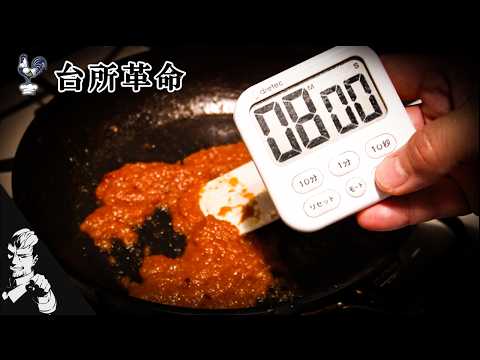
Ingredients
- Onion:350g
- Butter:10g
- Bakingsoda (sodium bicarbonate): 0.35g (0.1% of onion weight)
About "Super-Fast Caramelized Onions Using Baking Soda"
This video introduces a time-saving technique to make caramelized onions in just 10 minutes by adding 0.35g (0.1%) of baking soda to 350g of onions. It explains the three scientific mechanisms of how an alkaline environment accelerates the Maillard reaction. While increasing the baking soda to 1% (3.5g) reduces the time to 8 minutes, it results in a soapy taste, making the 0.1% ratio an absolute rule. Since this method turns the onions into a puree, it is perfect for curry bases or French onion soup, but not suitable for dishes where you want to retain texture.
Introduction to フレンチシェフ高御仁のガチレシピ →
Video Timestamps
Tips for Making "Super-Fast Caramelized Onions Using Baking Soda"
-
Baking Soda Amount
- Always stick to exactly 0.1% of the onion's weight for the baking soda (0.35g for 350g of onions). Adding too much will result in an unpleasant, soapy taste.
-
Science Logic 1
- Shifting the pH to alkaline with baking soda causes amino acids to release hydrogen ions, making them highly active and ready to bind with sugars (amino acid activation).
-
Science Logic 2
- The alkaline environment accelerates sugar breakdown, causing a surge of reducing sugars—the reaction partners for amino acids—in the pan.
-
Science Logic 3
- Baking soda breaks down pectin in the cell walls, releasing moisture rapidly. Once evaporated, the pan quickly reaches 140–160°C, the optimal temperature for the Maillard reaction.
-
Best Uses
- Since this method completely dissolves the onion fibers into a puree, limit its use to dishes where dissolved onions are preferred, such as curry bases or French onion soup.
-
Comparison
- While traditional sautéing takes about 22 minutes and the moisture-squeezing separation method takes 12–15 minutes, this baking soda method takes only about 10 minutes.
-
Cooking Timeline
- Moisture releases heavily at 1 minute, onions break down significantly at 4 minutes, turn into a paste at 7.5 minutes, and caramelize beautifully at 10 minutes.
Ingredients for "Super-Fast Caramelized Onions Using Baking Soda"
3 items* Tap ingredient names to find on Amazon
How to Make "Super-Fast Caramelized Onions Using Baking Soda"
- 1
Thinly slice 350g of onions.
- 2
Melt 10g of butter in a pan and add the onions.
- 3
Start a timer and add 0.35g of baking soda.
- 4
Continue sautéing (a large amount of moisture will start to release in about 1 minute).
- 5
At around 4 minutes, the onions will break down significantly, and by 7.5 minutes, they will become paste-like.
- 6
Turn off the heat once the caramelized onions are ready at around 10 minutes.
Detailed Commentary on "Super-Fast Caramelized Onions Using Baking Soda"
* Content organized by topics from the video.
The 0.1% Baking Soda Caramelized Onion Experiment
In this episode of 'Kitchen Revolution' presented by chef VTuber Takami Jin, we harness the power of alkalinity for a 'super-fast caramelized onion' experiment. We prepare 350g of onions and 10g of butter—the same conditions as our previous video—but the key difference is adding just '0.1% baking soda.' We add a mere 0.35g of baking soda to the 350g of onions. After melting the butter in a pan, adding the onions, starting the timer, and tossing in the baking soda, an amazing transformation begins immediately. Just 1 minute into sautéing, moisture starts gushing out, and by the 2-minute mark, the pan is flooded with liquid. At 4 minutes, the onions break down significantly, and by 7.5 minutes, they turn almost completely into a paste. Finally, at the 10-minute mark, a beautiful deep-brown caramelized onion paste is complete. Caramelized onions, which normally take an agonizingly long time, are done in just 10 minutes.
The Soapy Trap: Never Add Too Much Baking Soda
To answer the question, 'Won't adding more baking soda make it even faster?', we conduct an interesting experiment. Using the same amount of onions, we add 3.5g of baking soda—about 10 times the original amount—and sauté them. The moisture release accelerates even further, flooding the pan in just 1.5 minutes. By the 4-minute mark, the color begins to deepen rapidly as the water evaporates. At 6.5 minutes, it reduces coarsely, and in just 8 minutes, a fully caramelized onion paste is complete. However, there is a terrible trap. When you actually taste it, it has a shocking 'soapy flavor.' This is a unique phenomenon that occurs when too much alkali (baking soda) is added. No matter how fast it is, sacrificing the deliciousness of the dish defeats the purpose. Keeping the baking soda at a microscopic '0.1%' is an absolute rule.
Comparing Methods and When to Use This Hack
Let's compare this with the professional techniques introduced in our previous video. Sautéing onions the traditional way takes 22 minutes to caramelize. The 'separation method,' where you squeeze out the onion's moisture before cooking, reduces the time to 15 minutes (or 12 minutes with some extra effort), but it slightly sacrifices texture as the edges of the fibers soften. While this 'baking soda (alkaline) method' is incredibly fast at 10 minutes, the fibers completely dissolve, turning the onions into a puree. Therefore, you should never use this technique for dishes where you want to retain a crisp onion texture. However, for bases where dissolved onions are perfectly fine—such as French onion soup or a rich curry paste—this is an unbeatable time-saving hack. It is important to choose the right technique based on your culinary goals.
The Science of Why Alkali Speeds Up Caramelization
Why does adding baking soda make onions caramelize so quickly? The secret lies in three chemical changes triggered by alkalinity. First is the 'activation of amino acids.' Raw onions are slightly acidic, meaning amino acids hold onto hydrogen ions, shielding them and making them less likely to bind with sugars. Shifting the environment to alkaline with baking soda strips away these hydrogen ions, forcing the amino acids into an ultra-active state. Second is the 'surge of reducing sugars.' The alkaline environment dramatically accelerates sugar breakdown, flooding the pan with the perfect partners for the amino acids. Third is the 'rapid evaporation of moisture.' Baking soda breaks down the pectin in the cell walls, squeezing the water out of the onions instantly. The moment this moisture evaporates over high heat, the pan's temperature breaks past the 100°C limit and rushes into the 140–160°C range—the optimal temperature for the Maillard reaction.
How Pros and Food Industries Use Alkalinity
This technique of shifting pH to alkaline is widely applied in the food industry and professional kitchens. For example, soaking chicken breast—which easily dries out—in baking soda water loosens the proteins and dramatically increases water retention, resulting in fried chicken that stays juicy even when cold. Alkali is also used to give frozen shrimp a plump texture, though professional steps like 'rubbing with salt, rinsing, and finishing with potato starch and sake' are essential to eliminate soapy foaming and odors. It is also used in various other ways: boiling black beans and other legumes faster to make them tender, neutralizing the sharp acidity of tomato sauce with a tiny pinch of baking soda to make it mild, or mixing baking soda into fried chicken batter to create carbon dioxide gas for a crispy finish. It is even used as an industrial safety measure to break down squid skin with alkali before frying calamari to prevent oil splattering and explosions.
Chef Takami's Challenge: Solve the Sesame Mystery
Finally, I have an 'urgent mission' and a challenge for our viewers. Black sesame seeds naturally have a strong harshness, bitterness, and astringency around their hulls, which is typically masked with sweetness in desserts to make them palatable. However, the 'black sesame soup' I created has absolutely no harshness or bitterness; only the rich, direct flavor of sesame remains, and it has a beautiful, deep black color. I used only black sesame and regular milk—no other black ingredients like black beans. Furthermore, the pH of this soup is completely 'neutral.' Mastering the logic of pH (acidity and alkalinity) makes this kind of perfect prep work possible. Why did the bitterness disappear while the color and flavor remained? If you think you know the answer, please share your theories in the comments. Once we hit 10,000 subscribers, I will release a video revealing all the secrets.
About フレンチシェフ高御仁のガチレシピ

フレンチシェフ高御仁のガチレシピ
6,310人 subscribers ・ フランス料理
* Opens YouTube channel
* Subscriber count is as of article creation and may differ from the current number.
