

Recipe
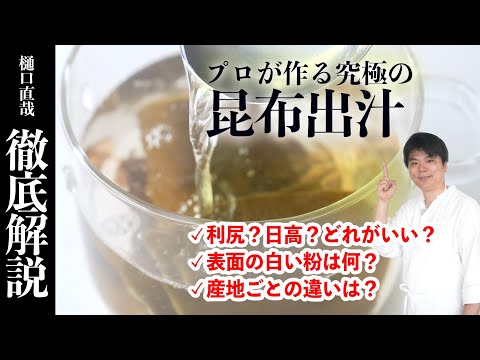
The Ultimate Guide to Kombu Dashi! From Basic Broth to Variety Comparisons
Ingredients
- 1000ml Water
- 10gKombu (Rausu kombu recommended)
About "Kombu Dashi (Kelp Stock)"
An introductory guide to kombu dashi, the foundation of Japanese stock. Learn about kelp varieties, characteristics, grades, and how to choose the best one. We cover how to use Rausu kombu, the science behind heating temperatures and times, and practical home-brewing methods. Discover how to extract savory umami compounds like glutamic acid.
Introduction to 樋口直哉の料理論[Cooking theory] →
Video Timestamps
Tips for Making "Kombu Dashi (Kelp Stock)"
-
Choosing Kombu
- We recommend Rausu kombu for home use. It has a strong umami flavor, extracts easily in small amounts, and the spent kelp is edible. Rishiri kombu is elegant but less suited for home cooking.
-
Cold Brewing
- The basic method is cold brewing 10g of kombu in 1L of water for 30 minutes or more. However, for home cooking, heating to extract all the flavor is key.
-
Heating Temp
- '60°C (140°F) for 1 hour' is a standard for high-end restaurants using Kyoto's soft water. At home, simmering at 100°C (212°F) for 5 to 10 minutes still yields high sensory scores and is perfectly fine.
-
Kombu Prep
- The white powder on the surface is mannitol. If you are concerned about dirt, simply wipe it with a dry cloth. No washing required.
-
Umami Science
- Kombu is the ingredient with the highest glutamic acid content. There is no difference in umami based on grade, and even with a 15-minute cold brew, Rausu kombu and Ma-kombu extract the most umami compounds.
Ingredients for "Kombu Dashi (Kelp Stock)"
2 items* Tap ingredient names to find on Amazon
How to Make "Kombu Dashi (Kelp Stock)"
- 1
If you are concerned about the surface of the kombu, gently wipe it with a dry cloth.
- 2
Add 1000 ml of water and 10g of kombu to a pot.
- 3
Start heating over medium or low heat.
- 4
When small bubbles appear on the bottom and sides of the pot, it is a sign that the temperature has reached 60°C (140°F).
- 5
If using Rausu kombu, continue heating on low for about 10 minutes.
- 6
Once the kombu becomes soft and has no flavor left when tasted, the dashi has been fully extracted.
- 7
Remove the kombu to use the dashi. The leftover kelp can be thinly sliced and used in stir-fries, kinpira, etc.
Food Science
Glutamic acid, which is abundant in kombu, is a representative amino acid-based umami compound. This umami compound is efficiently extracted by heating slowly at around 60°C (140°F) without boiling, which prevents the release of off-flavors and slimy substances. By controlling the temperature with medium or low heat and maintaining the temperature where bubbles just begin to form, you can draw out a clean yet deep and rich umami flavor.
Detailed Commentary on "Kombu Dashi (Kelp Stock)"
* Content organized by topics from the video.
Japanese Dashi Basics & Kombu Fundamentals
Hi, I'm Naoya Higuchi, an author and chef. Today, I will explain Japanese dashi, the foundation of Japanese cuisine, focusing specifically on kombu dashi. At its core, dashi is a liquid that extracts the umami and aroma of ingredients into water, and it can be made from almost anything. For example, simmering daikon radish in water yields daikon dashi. The most widely used variety is awase dashi, a combination of kombu and bonito flakes. Kombu dashi is the perfect entry point to Japanese stock because you can make it almost instantly just by soaking kombu in water. On the other hand, people often feel it tastes a bit 'lacking.' There are 45 species across 14 genera of kombu, and Japanese people consume about 10 of them. No other ingredient contains as much glutamic acid as kombu, making it the backbone of Japanese cuisine. There are two types of kombu: wild and farmed, though wild kelp has decreased drastically in recent years. Different regions produce different varieties: the Pacific side yields Naga-kombu, Hidaka kombu, and Rausu kombu; the Sea of Japan and Sea of Okhotsk coasts yield Rishiri kombu; and the Hakodate area yields Ma-kombu.
Kombu Varieties and Their Characteristics
When you go to the supermarket, you see many types of kombu, and it can be hard to know which one to buy. Let me explain the four main varieties. First, Ma-kombu (also known as Yama-dashi kombu) is especially popular in Osaka. It yields a pale, sweet, and elegant dashi. Next, Rishiri kombu is a favorite of high-end Kyoto restaurants (ryotei) and is characterized by its wavy shape. Because its flesh is hard, it takes effort to extract, but it yields an incredibly clear, clean-tasting dashi. Then there is Rausu kombu (scientifically known as *Rishiri-kei Enaga-oni-kombu*), which is characterized by its wide leaves. It is produced with immense labor, including sun-drying and damp-stretching, and yields a rich, yellowish dashi. This Rausu kombu is what I mainly use. Finally, Hidaka kombu (known as Mitsuishi-kombu) has soft fibers and cooks quickly, making it suitable not just for dashi but also for eating, such as in tsukudani (simmered kelp). It yields a dashi with a strong ocean aroma, often used for oden broth in Tokyo.
Kombu Grades and the Science of Selection
In addition to varieties, kombu is classified into grades from 1st to 4th based on leaf width and thickness. Naturally, lower grades are cheaper. To answer the question 'Is expensive kombu tastier?', a paper titled *Relationship Between Kombu Grades and Dashi Components* by Dr. Nakako Matsumoto and colleagues at Kagawa Nutrition University analyzed the components of 1st, 2nd, and 3rd grade Rishiri kombu. The results showed no significant difference in umami components like amino acids and nucleotides. In other words, if you are using it for dashi, the grade doesn't matter much. Furthermore, according to data from the Umami Information Center, the glutamic acid content per 100g is highest in Rausu kombu, followed by Ma-kombu, Rishiri kombu, and Hidaka kombu. Even when comparing a 15-minute cold brew, Rausu kombu and Ma-kombu yield higher amounts of umami-rich glutamic acid and aspartic acid, as well as sweet-tasting alanine and glycine.
The Best Kombu for Home Cooking
Which kombu is best for home cooking? While Rishiri kombu, loved by high-end restaurants, is elegant, its umami is subtle. You need to use a lot of it to get a robust flavor, which gets expensive. Moreover, home-cooked miso soup or nimono (simmered dishes) doesn't require the extreme refinement of a high-end restaurant. Therefore, for daily use, I recommend Rausu kombu, which has a strong umami profile and yields a rich dashi even in small amounts. There are two more reasons I recommend Rausu kombu. First, because its fibers are soft, the spent kelp (dashigara) left after brewing is delicious to eat. You can snip it with scissors to add to miso soup or eat it directly with yudofu (hot tofu). Second, it releases its flavor easily. Hard Rishiri kombu softens quickly in Kyoto's soft water, but takes time in Tokyo's water. Rausu kombu has softened fibers due to its manufacturing process, so it yields a rich dashi quickly even in Tokyo's water. If you can't find Rausu kombu at the supermarket, Ma-kombu is a great alternative.
How to Make Kombu Dashi & Temperature Secrets
The basic method for making kombu dashi is the cold brew method, where you place 10g of kombu in 1L of water and let it sit for 30 minutes or more to get a high-quality stock. However, cold brewing alone leaves behind valuable umami compounds in the kelp, so heating is common. That said, if you boil it too much, the kombu releases sliminess and off-flavors, making it smell overly 'kelpy' or taste heavy. This is why the golden rule has always been to 'remove the kombu just before boiling.' Recently, a research report from the Japanese Culinary Academy suggested that extracting at 60°C (140°F) for 1 hour yields the most delicious result. However, this is not an absolute rule. This experiment was tailored for high-end restaurants using Kyoto's soft water and Rishiri kombu. At home, we don't usually make nibandashi (second-dashi), so it's important to extract all the flavor in one go. According to Dr. Matsumoto's paper, simmering at 100°C (212°F) for 5 to 10 minutes still receives high sensory evaluation scores; as long as you don't over-boil it, it's perfectly fine. You can be much more relaxed about making dashi at home.
Step-by-Step: Making Dashi with Rausu Kombu
Let's actually make dashi using Rausu kombu. Prepare 10g of kombu (1% ratio) for 1000 ml of water. The white powder on the surface of the kombu is often mistaken for pure umami, but it is actually mannitol, a type of sugar alcohol that provides a very subtle sweetness. If you are concerned about dirt, you can wipe it with a dry cloth, but I use it as is. If you have time, soak it in water for 30 minutes, but since Rausu kombu holds up well to heat, you can start heating it right away. To allow enough extraction time, set the heat to medium or low. After a while, small bubbles will appear on the bottom and sides of the pot. This is the sign that it has reached 60°C (140°F). For Ma-kombu or Rishiri kombu, you would turn the heat to extremely low or turn it off here, but since Rausu kombu is robust, we continue heating it on low for 10 minutes. Once the kombu is soft and has no flavor left when tasted, the dashi is fully extracted. The finished dashi has a very light mouthfeel but a rich, deep umami. Thinly slice the spent kelp (dashigara) and enjoy it in stir-fries, kinpira, or sweet vinegar pickles.
About 樋口直哉の料理論[Cooking theory]
樋口直哉の料理論[Cooking theory]
7.9万人 subscribers ・ 家庭料理/調理科学
* Opens YouTube channel
* Subscriber count is as of article creation and may differ from the current number.
